.NET

Topics specific to .NET development.

VS2010: Box Selections

When I first saw the box selection capabilities in Visual Studio 2010 I thought “that’s kind of neat but I’ll probably never use it” and promptly moved on.  I couldn’t have been more mistaken.  In fact, nearly two years later, box selection has become one of those features that I use almost daily.  What surprises me now though is how many developers I run into that still don’t know about them.

Box selections let us quickly make the same change to multiple lines simultaneously.  Creating them is easy – just hold shift+alt and use the arrow keys or hold the alt key while left drag the mouse to define a rectangle.  If you just want to insert the same text onto multiple lines you can define a zero-length box by expanding the box vertically in either direction.

Non-virtual Properties

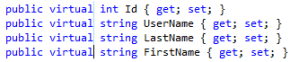
So what makes box selections so useful?  Some of the things I find them most useful for are changing modifiers and making local variables implicitly typed.  To illustrate, let’s take a look at a few non-virtual properties that we’d like to make virtual.

Zero-Length Selection

Making these properties virtual without a box selection certainly isn’t difficult but it’s definitely tedious.  A box selection lets us make them all virtual at the same time so we can get on with the task at hand.  The thin blue line immediately following the public modifier on each property identifies the zero-length box that serves as the point where we’ll insert in the virtual modifier.

Virtual PropertiesTo insert the virtual modifier we just need to type (or paste) “virtual.”  Here you can see that each property is now virtual and the zero-length box has moved to the end of the inserted text.  What if we decide later though that these properties shouldn’t be virtual after all?

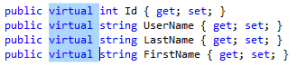
Box SelectionWe can use box selections to remove the virtual modifier from each property just as easily.  In the example to the left we see a box selection highlighting the virtual modifier on each line.  Non-virtual Properties 2To remove the text we can simply delete it.  This will leave us with a zero-length box where the virtual modifiers used to be.  We can then simply click or arrow away to clear the box selection.

Box selections can go a long way toward increasing your productivity by reducing some of the more tedious aspects of programming.  The few seconds they save here and there can really add up over the course of a day.  More importantly though, that time can be spent on the real problems we’re trying to solve.

Further Reading

How to: Select and Change Text

System.Diagnostics.Debugger

I hardly ever use the classes in the System.Diagnostics namespace.  As much as I’d like everyone to believe that it’s because I’m such a rockstar that I don’t need them, it’s really just that I generally use other techniques.  With Visual Studio providing so many tools for debugging I’ve rarely had reason to dig into this namespace much.  Sure, I’ve used the Debug, Trace, and EventLog classes but I haven’t taken the time to investigate what else is in there.

(more…)

Cast or GetHashCode?

I really hate to resurrect this issue but after some recent conversations I think it’s necessary.  We have a lot of code – particularly in the deep, dark recesses of our application that no one dares touch – that uses GetHashCode() to retrieve the underlying value of an enumeration item.

I’ve been slowly working to eliminate this technique from the system but it works, has been in use for eight or so years, and old habits die hard.  An unfortunate side effect though, is that less experienced developers see this pattern repeated throughout the code, internalize the practice, and propagate it.  If GetHashCode() works why should we care?

(more…)

Speaking in Fort Wayne

If you missed my Parallel Programming in .NET 4 talk at IndyNDA on June 9th you now have another chance!  I’ll be giving the same presentation to the .NET Users of Fort Wayne (NUFW) on August 9, 2011 at 6:00 PM. Be sure to check the NUFW site for registration and logistics.

I hope to see you there!

NUFW Logo

June Speaking Engagement – IndyNDA

I’ll be speaking at the 126th meeting of IndyNDA. In this session I’ll cover Parallel Programming in .NET 4 and as a bonus show some of the features included in the Visual Studio Async CTP.  I hope to see you there!

Date/Time:
6/9/2011 6:00 PM
(5:30 registration)

Location:
Management Information Disciplines, LLC
9800 Association Court
Indianapolis, IN 46280
[Map]

Be sure the check the IndyNDA site for full logistics and other information.

Not Another Regular Expression

I haven’t done anything with the System.Drawing namespace directly in a long time.  So long in fact that before today I honestly can’t remember the last time I needed anything in there.  When I needed to update the border color on an old ASP.NET DataGrid and the compiler informed me that I couldn’t use a hex string I was a bit surprised.  I needed a way to convert that string to a System.Drawing.Color.

In my haste the first thing I did was start writing a method to parse out the string and get the integer values to pass in to Color.FromArgb.  Because I needed to account for both the 3-digit and 6-digit formats in both uppercase and lowercase characters with or without the leading hash I started hacking out a regular expression.

I haven’t had much reason to use regular expressions for a long time either but apparently (and amazingly) I can apparently remember their syntax better than I can remember what’s in System.Drawing because with minimal documentation referencing this is what I came up with:

var re = new Regex(
	@"^#?(?([\dA-F]{3}$)(?<r>[\dA-F])(?<g>[\dA-F])(?<b>[\dA-F])|(?<r>[\dA-F]{2})(?<g>[\dA-F]{2})(?<b>[\dA-F]{2}))$",
 RegexOptions.IgnoreCase
);

As irritating and confusing as the syntax is I’m always amazed at how powerful regular expressions are.  There’s really quite a bit going on in this example so let’s take a look at what it’s matching.  I won’t talk about the RegexOptions piece because that should be pretty self-explanatory but otherwise we can break this one down into a few pieces starting with the most basic.

We start and end with the ^ and $ characters.  These ensure that the string we’re checking is respectively the first and last thing on the line.  Immediately following the opening ^ we see the #? pattern that says a valid match will start with no more than one instance of the # character.

Throughout the expression we repeatedly see the [\dA-F] pattern.  On its own this pattern matches a single hexadecimal digit (0-9, A-F).  When we need to match multiple consecutive hexadecimal digits we follow the pattern with a quantifier like {2} or {3}.

The remaining constructs in the expression deal with groups and conditional matching (formally called alternation).  These constructs look similar and are closely related.  In this example we’re using two types grouping patterns and an alternation pattern.  It’s probably best to start with the outermost construct and work our way in.

In this example alternation construct follows the (?(expression)yes-part|no-part) syntax.  I like to think of this conditional matching construct as the regular expression version of the ternary operator.  The expression is a zero-width assertion construct (non-advancing) that is used to determine whether the yes-part or no-part pattern should be matched.  Most of the time the construct for a zero-width assertion begins with (?= but in this case the assertion is is implied and the .NET regular expression parser allows us to omit the ?=.  In this example our zero-width assertion is ([\dA-F]{3}$).  That is, we’re evaluating whether the string matches exactly 3 hexadecimal digits followed by the end of the line.  In short, if the string is a 6-digit format the parser will match the “yes” part otherwise it will match the “no” part.  The reason we’re asserting the end of line here too is that we want to ensure that a 6-digit color doesn’t fall in to the “yes” part.

Note: Alternatively we could assert [\dA-F]{6} and swap the yes/no parts.

The “yes” and “no” parts are very similar in that they both consist of three named capturing groups: “r”, “g”, and “b”.  The named capturing groups are identified by the (?<name>pattern) syntax and instruct the parser to remember the values for use later in the pattern through backreferences or returning to C# via the Groups collection on the Match object.  Since we’ve really covered what the pattern does we won’t go into detail here.  We just need to recognize that when we’re matching a 3-digit color we capture the individual digits whereas when we have a 6-digit color we capture pairs of digits.  By using the same names in both parts our C# code can be completely ignorant of how the expression captured them.

Note: Regular expressions also allow for unnamed capturing groups that can be referred to by their ordinal index.  Even though they add clutter to an already potentially confusing string I usually stick to the named capturing groups because they make it easier to remember which group I’m working with.

This regular expression did the trick nicely.  I was able to extract the individual color components from both 3-digit and 6-digit color codes and fail out of anything that didn’t match by checking the match’s Success property.  Unfortunately this was only part of the conversion process.  I still needed to convert the values from the 3-digit pattern over to their 6-digit equivalent and pass the integer values to Color.FromArgb.  At this point I got to thinking “there has to be an easier way” as though the regular expression wasn’t enough.

No matter how far you have gone on a wrong road, turn back.
– Turkish Proverb

Remember that I said that I haven’t done anything with the System.Drawing namespace directly in a long time…  It turns out that there’s a ColorTranslator class in System.Drawing that provides a nice FromHtml method.  FromHtml takes a hex string and returns the equivalent System.Drawing.Color.  Problem solved.

Parallel Programming in .NET 4

Over the years software development has relied on increasing processor clock speeds to achieve better performance.  For better or worse though the trend has changed to adding more processing cores.  Generally speaking, software development hasn’t adjusted to account for this transition.  As a result many applications aren’t taking full advantage of the underlying platform and therefore they’re not performing as well as they could.  In order to take advantage of multi-core and multi-processor systems though we need to change the way we write code to include parallelization.

Historically, parallel programming has been viewed as the realm of highly specialized software where only experts dared to tread.  Parallel programming aims to improve performance by executing multiple operations simultaneously.  The .NET framework has always supported some level of parallel programming.  It has included threads and locks all the way back to the early days of the framework.  The problem with threads and locks though is that using them correctly is difficult and error prone.  Where do I need locks?  Can I lock on this?  Should I use lock, ReaderWriterLock, or ReaderWriterLockSlim?  How do I return a result from another thread?  What’s the signature for the ThreadStart delegate passed to the Thread constructor?  These questions haven’t even started to touch on pooling, deadlocks, exception handling, cancellations, or a multitude of other considerations.  .NET 4 doesn’t eliminate these classes but builds upon them.
(more…)

Building Strings Fluently

Last night I was reading the second edition of Effective C#.  Item 16 discusses avoiding creation of unnecessary objects with part of the discussion using the typical example of favoring StringBuilder over string concatenation.  The tip itself was nothing new, StringBuilder has been available since the first versions of the .NET framework, but it did remind me of something I “discovered” a few months ago.

Back in late July Esther and I took a week vacation.  We rented a two story loft on a marina in southwest Michigan.  It was incredibly relaxing and apparently more refreshing than I realized at the time.  When I returned to the office the following Monday I was looking at a block of code that was doing a lot of string concatenation and decided to rewrite it to use a StringBuilder instead.  When using a StringBuilder I follow the familiar pattern seen in most books and even in the MSDN documentation:

var sb = new StringBuilder();
sb.Append("Hello, Dave");
sb.AppendLine();
sb.AppendFormat("Today is {0:D}", DateTime.Now);
Console.WriteLine(sb.ToString());

For some reason though as I was writing code this particular Monday I noticed something that I hadn’t noticed before.  I realized that StringBuilder, a class I’ve been using for nearly 10 years, implements a fluent interface!  All of those familiar methods like Append, AppendFormat, Insert, Replace, etc… each return the StringBuilder instance meaning we can chain calls together!

Armed with this new knowledge I started thinking about all the places that code can be simplified just by taking advantage of the fluent interface.  No longer do I need to define a variable for the StringBuilder and pass it to something.  Instead, I can create the instance inline, build it up, then pass it along.

Console.WriteLine(
		(new StringBuilder())
		.Append("Hello, Dave")
		.AppendLine()
				.AppendFormat("Today is {0:D}", DateTime.Now)
		.ToString()
);

Hoping I hadn’t been completely oblivious for so long I hopped over to the .NET 1.1 documentation and what I found was astonishing – this functionality has been there all along.  I asked a few trusted colleagues if they knew about it and incredibly none of them had realized it either!  How did we miss this for so long?

LINQed Up (Part 4)

This is the fourth part of a series intended as an introduction to LINQ.  The series should provide a good enough foundation to allow the uninitiated to begin using LINQ in a productive manner.  In this post we’ll look at the performance implications of LINQ along with some optimization techniques.

LINQed Up Part 3 showed how to compose LINQ statements to accomplish a number of common tasks such as data transformation, joining sequences, filtering, sorting, and grouping.  LINQ can greatly simplify code and improve readability but the convenience does come at a price.

LINQ’s Ugly Secret

In general, evaluating LINQ statements takes longer than evaluating a functionally equivalent block of imperative code.

Consider the following definition:

var intList = Enumerable.Range(0, 1000000);

If we want to refine the list down to only the even numbers we can do so with a traditional syntax such as:

var evenNumbers = new List<int>();

foreach (int i in intList)
{
	if (i % 2 == 0)
	{
		evenNumbers.Add(i);
	}
}

…or we can use a simple LINQ statement:

var evenNumbers = (from i in intList
					where i % 2 == 0
					select i).ToList();

I ran these tests on my laptop 100 times each and found that on average the traditional form took 0.016 seconds whereas the LINQ form took twice as long at 0.033 seconds.  In many applications this difference would be trivial but in others it could be enough to avoid LINQ.

So why is LINQ so much slower?  Much of the problem boils down to delegation but it’s compounded by the way we’re forced to enumerate the collection due to deferred execution.

In the traditional approach we simply iterate over the sequence once, building the result list as we go.  The LINQ form on the other hand does a lot more work.  The call to Where() iterates over the original sequence and calls a delegate for each item to determine if the item should be included in the result.  The query also won’t do anything until we force enumeration which we do by calling ToList() resulting in an iteration over the result set to a List<int> that matches the list we built in the traditional approach.

Not Always a Good Fit

How often do we see code blocks that include nesting levels just to make sure that only a few items in a sequence are acted upon? We can take advantage of LINQ’s expressive nature to flatten much of that code into a single statement leaving just the parts that actually act on the elements. Sometimes though we’ll see a block of code and think “hey, that would be so much easier with LINQ!” but not only might a LINQ version introduce a significant performance penalty, it may also turn out to be more complicated than the original.

One such example would be Edward Tanguay’s code sample for using a generic dictionary to total enum values.  His sample code builds a dictionary that contains each enum value and the number of times each is found in a list. At first glance LINQ looks like a perfect fit – the code is essentially transforming one collection into another with some aggregation.  A closer inspection reveals the ugly truth.  With Edward’s permission I’ve adapted his sample code to illustrate how sometimes a traditional approach may be best.

For these examples we’ll use the following enum and list:

public enum LessonStatus
{
	NotSelected,
	Defined,
	Prepared,
	Practiced,
	Recorded
}

List<LessonStatus> lessonStatuses = new List<LessonStatus>()
{
	LessonStatus.Defined,
	LessonStatus.Recorded,
	LessonStatus.Defined,
	LessonStatus.Practiced,
	LessonStatus.Prepared,
	LessonStatus.Defined,
	LessonStatus.Practiced,
	LessonStatus.Prepared,
	LessonStatus.Defined,
	LessonStatus.Practiced,
	LessonStatus.Practiced,
	LessonStatus.Prepared,
	LessonStatus.Defined
};

Edward’s traditional approach defines the target dictionary, iterates over the names in the enum to populate the dictionary with default values, then iterates over the list of enum values, updating the target dictionary with the new count.

var lessonStatusTotals = new Dictionary<string, int>();

foreach (var status in Enum.GetNames(typeof(LessonStatus)))
{
	lessonStatusTotals.Add(status, 0);
}
	
foreach (var status in lessonStatuses)
{
	lessonStatusTotals[status.ToString()]++;
}

TraditionalOutput

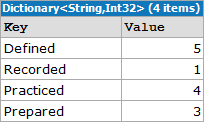
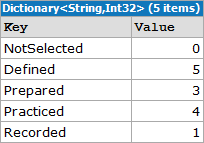
In my tests this form took an average of 0.00003 seconds over 100 invocations.  So how might it look if in LINQ?  It’s just a simple grouping operation, right?

var lessonStatusTotals =
	(from l in lessonStatuses
		group l by l into g
		select new { Status = g.Key.ToString(), Count = g.Count() })
	.ToDictionary(k => k.Status, v => v.Count);

GroupOnlyOutput

Wrong. This LINQ version isn’t functionally equivalent to the original. Did you see the problem?  Take another look at the output of both forms.  The dictionary created by the LINQ statement doesn’t include any enum values that don’t have corresponding entries in the list. Not only does the output not match but over 100 invocations this simple grouping query took an average of 0.0001 seconds or about three times longer than the original.  Let’s try again:

var summary = from l in lessonStatuses
				group l by l into g
				select new { Status = g.Key.ToString(), Count = g.Count() };
		
var lessonStatusTotals = 
	(from s in Enum.GetNames(typeof(LessonStatus))
	 join s2 in summary on s equals s2.Status into flat
	 from f in flat.DefaultIfEmpty(new { Status = s, Count = 0 })
	 select f)
	.ToDictionary (k => k.Status, v => v.Count);
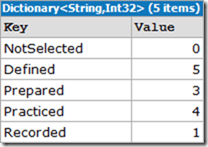
JoinAndGroupOutput

In this sample we take advantage of LINQ’s composable nature and perform an outer join to join the array of enum values to the results of the query from our last attempt.  This form returns the correct result set but comes with an additional performance penalty.  At an average of 0.00013 seconds over 100 invocations, This version took almost four times longer and is significantly more complicated than the traditional form.

What if we try a different approach?  If we rephrase the task as “get the count of each enum value in the list” we can rewrite the query as:

var lessonStatusTotals = 
	(from s in Enum.GetValues(typeof(LessonStatus)).OfType<LessonStatus>()
	 select new
	 {
	 	Status = s.ToString(),
		Count = lessonStatuses.Count(s2 => s2 == s)
	 })
	.ToDictionary (k => k.Status, v => v.Count);

CountOutput

Although this form is greatly simplified from the previous one it still took an average of 0.0001 seconds over 100 invocations.  The biggest problem with this query is that it uses the Count() extension method in its projection.  Count() iterates over the entire collection to build its result.  In this simple example Count() will be called five times, once for each enum value.  The performance penalty will be amplified by the number of values in the enum and the number of enum values in the list so larger sequences will suffer even more.  Clearly this is not optimal either.

A final solution would be to use a hybrid approach.  Instead of joining or using Count we can compose a query that references the original summary query as a subquery.

var summary = from l in lessonStatuses
	group l by l into g
	select new { Status = g.Key.ToString(), Count = g.Count() };

var lessonStatusTotals =
	(from s in Enum.GetNames(typeof(LessonStatus))
	 let summaryMatch = summary.FirstOrDefault(s2 => s == s2.Status)
	 select new
	 {
	 	Status = s,
		Count = summaryMatch == null ? 0 : summaryMatch.Count
	 })
	.ToDictionary (k => k.Status, v => v.Count);

SubqueryOutput

At an average of 0.00006 seconds over 100 iterations this approach offers the best performance of any of the LINQ forms but it still takes nearly twice as long as the traditional approach.

Of the four possible LINQ alternatives to Edward’s original sample none of them really improve readability.  Furthermore, even the best performing query still took twice as long.  In this example we’re dealing with sub-microsecond differences but if we were working with larger data sets the difference could be much more significant.

Query Optimization Tips

Although LINQ generally doesn’t perform as well as traditional imperative programming there are ways to mitigate the problem.  Many of the usual optimization tips also apply to LINQ but there are a handful of LINQ specific tips as well.

Any() vs Count()

How often do we need to check whether a collection contains any items?  Using traditional collections we’d typically look at the Count or Length property but with IEnumerable<T> we don’t have that luxury.  Instead we have the Count() extension method.

As previously discussed, Count() will iterate over the full collection to determine how many items it contains.  If we don’t want to do anything beyond determine that the collection isn’t empty this is clearly overkill.  Luckily LINQ also provides the Any() extension method.  Instead of iterating over the entire collection Any() will only iterate until a match is found.

Consider Join Order

The order in which sequences appear in a join can have a significant impact on performance.  Due to how the Join() extension method iterates over the sequences the larger sequence should be listed first.

PLINQ

Some queries may benefit from Parallel LINQ (PLINQ).  PLINQ partitions the sequences into segments and executes the query against the segments in parallel across multiple processors.

Bringing it All Together

As powerful as LINQ can be at the end of the day it’s just another tool in the toolbox.  It provides a declarative, composable, unified, type-safe language to query and transform data from a variety of sources.  When used responsibly LINQ can solve many sequence based problems in an easy to understand manner.  It can simplify code and improve the overall readability of an application.  In other cases such as what we’ve seen in this article it can also do more harm than good.

With LINQ we sacrifice performance for elegance.  Whether the trade-off is worth while is a balancing act based on the needs of the system under development.  In software where performance is of utmost importance LINQ probably isn’t a good fit.  In other applications where a few extra microseconds won’t be noticed, LINQ is worth considering.

When it comes to using LINQ consider these questions:

  • Will using LINQ make the code more readable?
  • Am I willing to accept the performance difference?

If the answer to either of these questions is “no” then LINQ is probably not a good fit for your application.  In my applications I find that LINQ generally does improve readability and that the performance implications aren’t significant enough to justify sacrificing readability but your mileage may vary.

Upcoming Events in Indianapolis

There are a few interesting software development related events coming up in Indianapolis over the next few weeks.


Indy TFS User Group

Date/Time:
10/13/2010 6:30 PM

Location:
Microsoft Corporation
500 E. 96th St.
Suite 460
Indianapolis, IN 46240
[Map]

Web Site:
https://www.clicktoattend.com/ invitation.aspx?code=151376

The first meeting of the Indianapolis TFS User Group will feature Paul Hacker introducing many of the Application Lifecycle Management tools in Visual Studio 2010.

I’ve been reading Professional Application Lifecycle Management with Visual Studio 2010 and am pretty excited about many of the features.  I hope to use this session to expand upon what is included in the book.

This event is free to attend.  Follow the link to the right to register.

IndyNDA

Date/Time:
10/14/2010 6:00 PM

Location:
Management Information Disciplines, LLC
9800 Association Court
Indianapolis, IN 46280
[Map]

Web Site:
http://indynda.org/

The October IndyNDA meeting will be presented by the group’s president, Dave Leininger.  Dave will be discussing ways to graphically represent complex relationships in data.

Three special interest groups (SIGs) also meet immediately following the main event.  The SIGs were on hiatus last month so I’ll be giving my introduction to dynamic programming in C# talk this month.

IndyNDA meetings are free to attend thanks to the sponsors.  No registration is required.  Regular attendees should note the new location.

Indy GiveCamp

Date/Time:
11/5/2010 – 11/7/2010

Location:
Management Information Disciplines, LLC
9800 Association Court
Indianapolis, IN 46280
[Map]

Web Site:
http://www.indygivecamp.org/

“Indy GiveCamp is a weekend-long collaboration between local developers, designers, database administrators, and non-profits. It is an opportunity for the technical community to celebrate and express gratitude for the contributions of these organizations by contributing code and technical know-how directly towards the needs of the groups.”

I can’t be participate in this year’s event due to prior family commitments but I’ve heard enough good things about the GiveCamp events in other cities to know that it’s a great cause.  There is still a need for volunteers so if you can spare the weekend please volunteer.  One of 18 charities will thank you for it.